下载App
资质规则
旅行
账户

Brun066
Seeing — and even more so, entering — this unusual sacred building leaves a lasting feeling.
Lankathilaka Image House的点评
点评:Lankathilaka literally means "the ornament of Lanka" or "the jewel of Lanka". As such, the name applies not only to this building in Polonnaruwa but also to another — dating from a later period — in Kandy.
It's a building that rises to a considerable height (17 meters); apart from the great "dagobas" in Anuradhapura, it's considered the tallest structure in ancient Sri Lanka.
The sense of verticality is heightened by the extreme narrowness of the single nave, designed to direct the worshippers' gaze exclusively toward the far end, where a towering standing Buddha rises in alignment with the structure's vertical lines; unfortunately, the head and upper torso of the statue have been lost.
The Vihara is constructed entirely of brick — including the vaulted ceilings — with exceptionally thick walls intended to evoke the style of rock-cut temples. It thus belongs to the category of Buddhist buildings known as "gedi-ge".
The exterior brick walls were once adorned with elaborate carvings, while the interior was likely covered in frescoes.
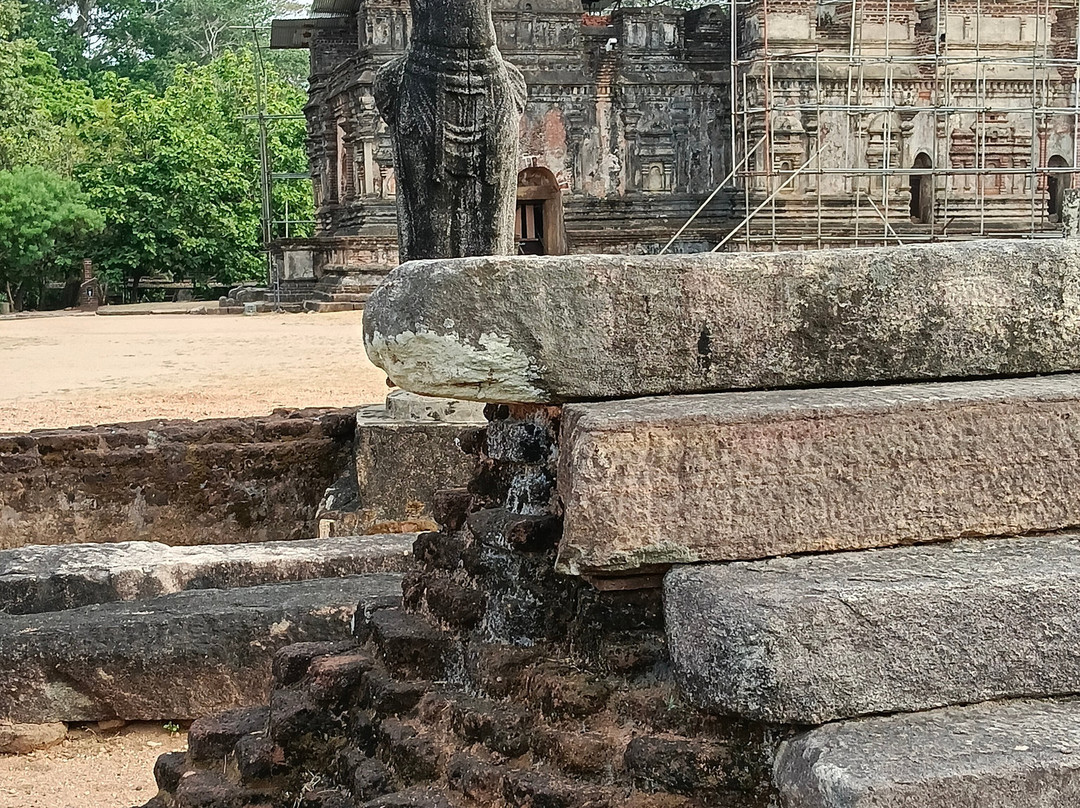
The staircase balustrades feature unusual ornamentation, consisting of a Naga on one side and a Nagini (female Naga) on the other.
All in all, seeing — and even more so, entering — this unusual building leaves a lasting feeling.
翻译:“Lankathilaka”的字面意思为“斯里兰卡的装饰”或“斯里兰卡的瑰宝”。因此,这个名字不仅适用于波隆纳鲁沃的这座建筑,也适用于康提另一座建造年代稍晚的建筑。
这是一座高度相当可观的建筑(17米);除了阿努拉德普勒的那些巨型佛塔外,它被认为是古代斯里兰卡最高的建筑物。
由于中央通道极其狭窄,这种垂直感愈发强烈。其设计旨在引导朝拜者的视线仅朝向远端——那里有一尊高大的立佛,其姿态与建筑物的垂直线条相呼应;遗憾的是,佛像的头部和上半身已散失不见。
这座佛寺完全由砖砌成——包括拱形天花板在内——其墙体极为厚实,旨在模仿石窟寺庙的风格。因此,它属于被称为“gedi-ge”的佛教建筑类型。建筑物的外墙砖面上曾经装饰着精美的雕刻,而内部很可能也曾绘有壁画。
楼梯的扶手上有独特的装饰图案:一侧是一条那伽,另一侧则是一位那伽女(雌性那伽)。
总而言之,亲眼目睹——更不用说走进——这座与众不同的建筑,会给人留下难以忘怀的印象。

© 2026 Tripadvisor 版权所有。
部分照片由 VFM Leonardo 提供。
TripAdvisor公司对外部网站的内容一概不负责。优惠价格中不含税和其他费用。
ICP证:沪B2-20200433
沪ICP备20013175号
 沪公网安备31010502005427号
鹰程信息技术(上海)有限公司